Emitter-Observer problem
As is customary, greek indices run from 0 to 3, latin indices from 1 to 3, and whenever the same index appears twice in an expression (once up and once down), it is being summed over.
In GR, one distinguishes between three different kinds of curves (or world lines) an object can follow in spacetime:
timelike curves (object moves with subluminal speed)
lightlike curves (object moves with speed of light)
spacelike curves (object moves with superluminal speed)
This feature is expressed in the world line’s normalisation condition
where
\(c\) is the speed of light,
\(g\) is the spacetime metric,
\(\dot{x}^\mu\) are the tangent vector components (four-velocity) at the event \(x\);
\(\varepsilon\) sets normalisation: 1 (timelike), 0 (lightlike), -1 (spacelike).
A dot over a variable denotes a derivative w.r.t. to some affine parameter \(s\). In the case of timelike curves and the normalisation chosen above, this parameter is called proper time \(\tau\) and is the time measured by a clock being carried along the world line.
The EOP focusses on objects moving on timelike curves (e.g. satellites or stars) exchanging light signals which move on lightlike curves. When a curve’s shape is only determined by spacetime curvature (no other force acting on it), these curves are called geodesics. While objects like satellites may follow either geodesic (freely moving) or non-geodesic (accelerated) curves, light signals are always described by lightlike geodesics.
Geodesics are described mathematically by the geodesic equation
where \(\Gamma^\mu_{\;\nu\rho}\) denotes the Christoffel symbols which contain information about the underlying spacetime geometry.
The setup is sketched in figure 1. It consists of two timelike curves \(\lambda(\tau), \tilde{\lambda}(\tilde{\tau})\) (that may or may not be geodesic), on which two events \(p, \tilde{p}\) are connected by one unique lightlike geodesic \(\gamma(s)\). In other words, one object following a timelike curve is associated with emitting a light signal (emitter) at proper time \(\tau_\text{e}\), the other with receiving the light signal (receiver) at proper time \(\tilde{\tau}_\text{r}\). Here, \(u := \dot{x}\), the tangent vector to the timelike curve at the corresponding event.
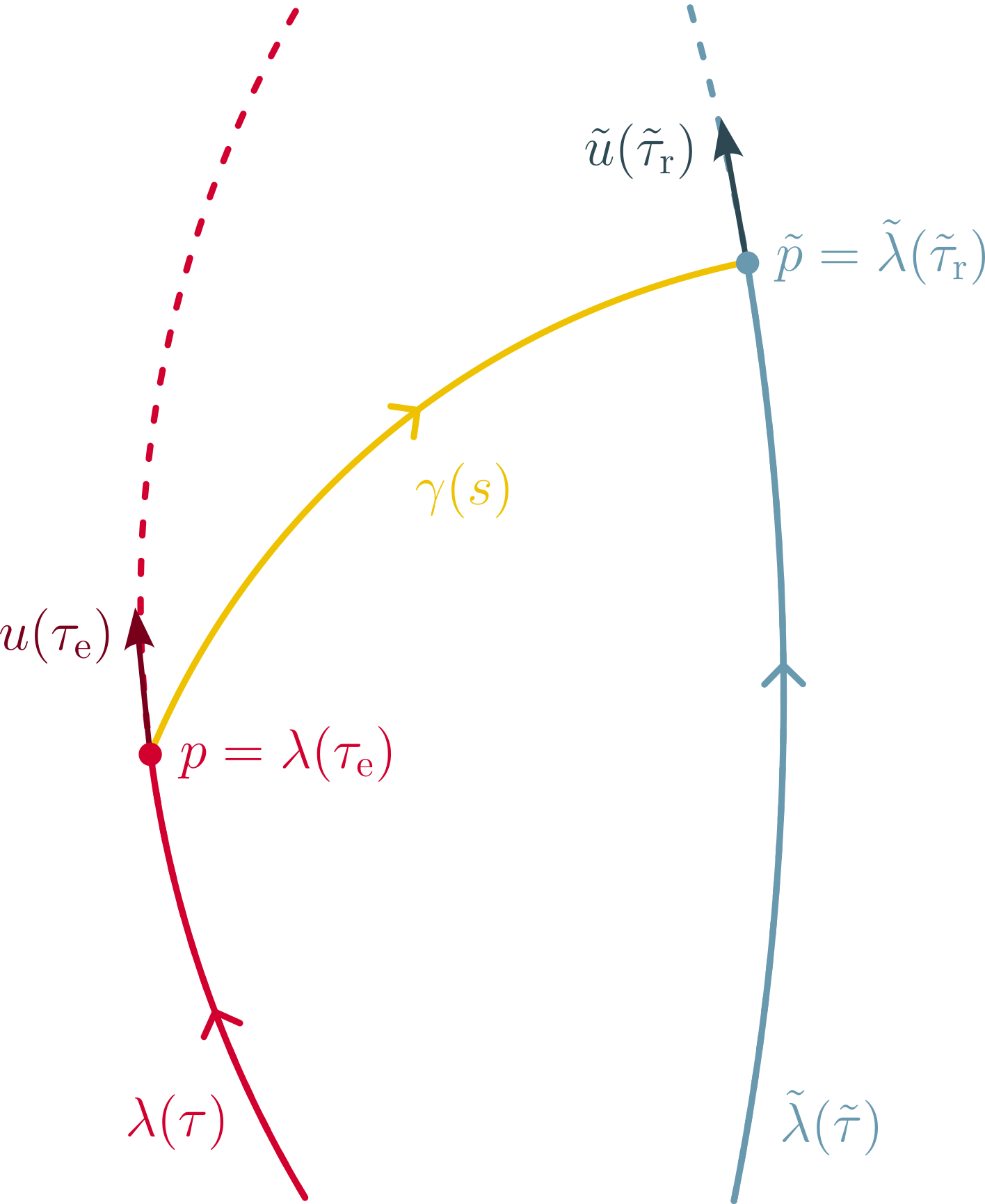
Fig. 1: The Emitter-Observer problem in terms of time- and lightlike geodesics.
The EOP is to calculate a corresponding lightlike geodesic from the geodesic equation (2) that connects two events on the timelike curves. Since the receiver moves during the propagation of the light signal, the reception event is unknown at the time of the emission event, wherefore the initial direction of the light signal w.r.t. some reference is also unknown. In this sense the EOP is about finding the correct initial directions of the lightlike geodesics (given by their emission event and corresponding tangent vector).